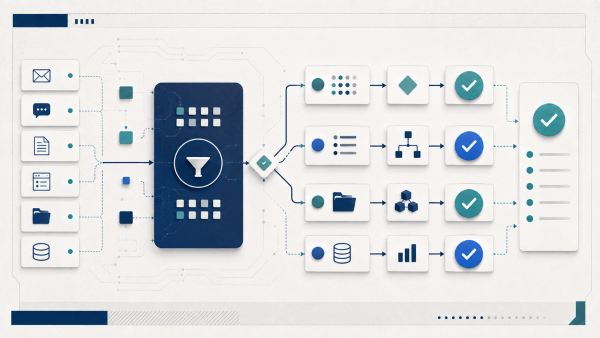
Deciding to automate a process is the easy part. Getting from that decision to something reliably running in production is where most of the real work — and most of the risk — actually sits. This page is an orientation to that journey: the stages a typical AI automation implementation moves through, and the most common reasons these projects disappoint. The two areas this site covers in the most depth — choosing the right process and connecting systems together — have their own dedicated guides, linked throughout.
Key takeaways
- Implementation typically moves through a small number of recognisable stages: selecting the right process, scoping and planning, building and integrating, testing, and deploying with monitoring in place.
- The most commonly cited causes of automation projects failing aren’t technical — they’re automating a process that wasn’t clearly understood to begin with, and underinvesting in change management.
- Testing on real or realistic data before full deployment, and monitoring after deployment rather than treating go-live as the finish line, both come up repeatedly across independent sources.
- This page is a map of the journey, not a full how-to for any single stage — dedicated guides cover process selection and integration mechanics in depth.
The typical implementation stages
Most AI automation implementations, regardless of the specific tools involved, move through a similar shape:
- Select the right process. Not every process is a good candidate, and getting this step wrong undermines everything after it. See How to Identify a Process Suitable for AI Automation for a dedicated framework.
- Scope and plan. Define what the automation actually needs to do, which systems it touches, and what success looks like before any building starts.
- Build and integrate. This is where the chosen tools and platforms actually get connected — commonly via APIs and webhooks. See How APIs and Webhooks Power Automation for how that connective layer works.
- Test before relying on it. IBM’s own guidance is direct on this point: “Successful implementation requires extensive testing and simulations of revised business processes.”2 Testing against real or realistic data, not just a happy-path demo, is what surfaces problems before they reach a live process.
- Deploy with monitoring built in, not bolted on afterwards. Go-live isn’t the finish line — an automation that isn’t monitored can quietly start failing without anyone noticing until the consequences show up downstream.
Why implementation projects most often fail
Two independent sources converge on largely the same causes, described in different words. KPMG names poor planning and misalignment with existing IT and processes as leading failure modes, stating that automation “requires a comprehensive and well-planned approach, rather than it being a quick experimentation project,” and that “failure to align with architecture and IT can lead to misuse, underutilization, or even complete disregard of automation technology.”1 IBM’s own research independently arrives at a closely related first cause: “Too often organizations automate broken or poorly executed processes.”2 Put together, the same underlying lesson shows up from two different angles: automating a process that isn’t well understood, well planned, or properly integrated with what already exists tends to produce a working demo and a disappointing rollout.
The second recurring theme is people, not technology. KPMG states plainly: “Without effective change management, employees may struggle to utilize the technology effectively due to a lack of understanding or fear of change.”1 An automation that technically works but that the people who need to use or trust it haven’t been prepared for tends to get quietly worked around rather than adopted.
Implementation considerations specific to AI-assisted steps
Everything above applies to automation generally, AI-assisted or not. A few considerations become more important once an AI-assisted step is involved: an AI-assisted step needs realistic test cases that cover its genuinely varied inputs, not just the tidy examples used during a demo; the people affected by an AI-assisted decision usually need a clearer explanation of what it can and can’t do than they would for a simple rule-based step; and monitoring needs to watch not just whether the system is running, but whether its outputs are still behaving as expected over time. How AI Automation Works covers the mechanics behind an individual AI-assisted step in more detail.
Where GrowAILab fits
Moving from a good idea to a properly implemented automation is where most of the practical risk in this page sits, and it’s easy to underestimate the planning, integration and change-management work involved. GrowAILab, the implementation partner behind AIAutomation.uk.com, works with UK businesses on Automation Implementation to build and connect the automation itself, Process Mapping to properly scope what’s being automated before building starts, and Platform and Technology Selection to choose the right tools for the job.
If you’re planning an implementation and want a structured view on scope, risk and approach before you start building, book an AI Automation Audit.
Frequently asked questions
What’s the single biggest reason implementation projects fail? Based on the sources reviewed for this page, automating a process that wasn’t clearly understood or well planned to begin with is the most consistently cited cause, closely followed by underinvesting in change management. See “Why implementation projects most often fail” above.
Do I need to test an automation before it goes live? Yes — testing against real or realistic data, not just a demo scenario, is one of the most consistently cited practices for avoiding a failed rollout. See “The typical implementation stages” above.
Is implementing an AI-assisted automation different from implementing a simple one? The overall stages are the same, but AI-assisted steps generally need more realistic test cases and clearer explanation to the people affected by them. See “Implementation considerations specific to AI-assisted steps” above.
Sources
The failure-cause and implementation-practice claims above are sourced to an international consultancy and an official vendor publication. No named-company outcome, saving, or performance figure from any source below is reproduced above:
- KPMG — “Five reasons why automation initiatives fail”, published 8 May 2024, accessed 30 July 2026.
- IBM Newsroom — “Five Reasons Why Business Automation Initiatives Fail and How to Avoid Them”, published 13 October 2022, accessed 30 July 2026.
This article is a general guide, not legal, financial or professional advice.